

But to persever
In obstinate condolement is a course
Of impious stubbornness. ’Tis unmanly grief.
If I had to sum up my philosophy of life, or maybe I just mean my spirituality or makeshift poetics — a ridiculous proposition either way — it would be that’ve I always tended to place more significance on what’s absent in my life than what’s present.
That is: what people don’t talk about in their daily conversations; the ever-looming void of one’s past; the sometimes almost permanent sense that one’s purpose or drive far from being empty or missing is, although desirable or fulfilling, still incomplete.
Does that sound, I don’t know, terribly depressing?
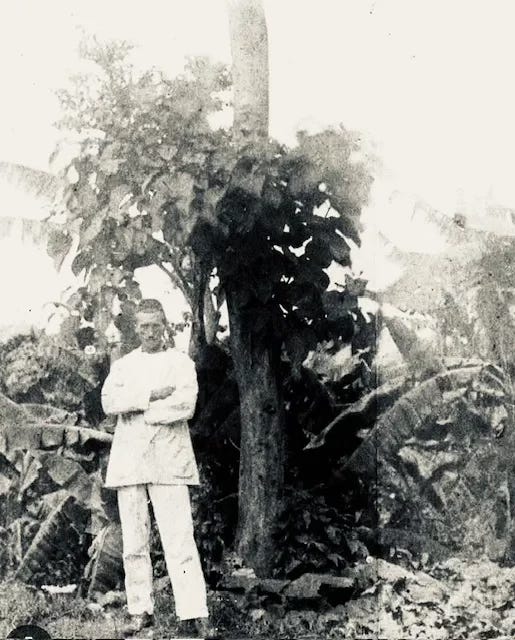
Rimbaud: “The true life is absent.”
What did Rimbaud mean by that? I once wanted to call my second book of poetry The True Life, or simply True Life. Not that I expected anyone to get the allusion. What the hell did Rimbaud even know about truth, whether fully lived or only imagined. He stopped writing poetry by the time he was 19. Talk about a quitter. And yet.
I recently watched a clip where Solmaz Sharif throws into question the whole tradition of taking Keats’ idea of “negative capability” seriously because he was after all 22 years old. Again, commonsensical wisdom might say (warranted): What the hell would some 22 year old know about aesthetic theory? Of course, he wouldn’t be equipped to acknowledge the consequences of being a white subject of the British Empire. Though it would grow yet bigger in the following century, by 1817, when a young Keats was about to pen his great odes, it already ‘had’ Canada, parts of India, South Africa, Australia, and maritime bases elsewhere.
I enjoy Sharif’s reality check. But I also reject its reductive ageism. If anything, as people get older they are less likely to take stock of a tragic sense of life, to acknowledge the personal and political ramifications of how we collectively live. Or fail to.
On the other hand, Joyce thought poets were the antennae of the race. I don’t know about that either.
Concerning Rimbaud, whose truncated, dramatic and certainly questionable life, leaves much to study and reexamine, I think it’s fair to say he did know what he was talking about. Childhood gives us enough material to brood upon for just about forever. Rimbaud inherited an absent military father; an overpowering mother; a life in Charleville that was far from satisfying for a young punk let alone ideal for a would-be prince of poets. The boy with wind in his heels.
Absence is not always a bad thing. But it’s also complicated. Bad, complicated… these colloquial expressions leave a lot of room for slack. They also get at the knot of experience. The double-faced gift that is age, time, relationships. Emily Wilson in her translation of The Odyssey by calling the hero of the epic “a complicated man.” No one had ever translated the opening like that. She comments brilliantly on this bold choice on her Substack:
… for some readers, “complicated” sounds “too modern”. The word “complicated” isn’t particularly modern in English (OED cites 1656 as the first known instance of the modern meaning). But maybe “complicated man” has been on the rise (Google ngram tells me that phrase, and “complicated relationship”, have risen in popularity since the turn of this century). Maybe for some people it has resonances of Facebook (which I don’t use or recommend to you), or, better, Avril Lavigne. But I actually like the Lavigne lyrics for “Complicated” as a text with a kind of resonance with the Odyssey: “acting like you’re somebody else” is a central feature of Odysseus’ polytropia, and it’s essential to how and why he survives – so if you do hear the song in the line, maybe it helps suggest the connotations of “many guises” that are there in the original word. Sometimes you do have to make everything so complicated, sometimes you gotta wear your preppy clothes and strike a pose (or at least get your multiple goddess makeovers), if you want to survive as the warrior king of Ithaca.
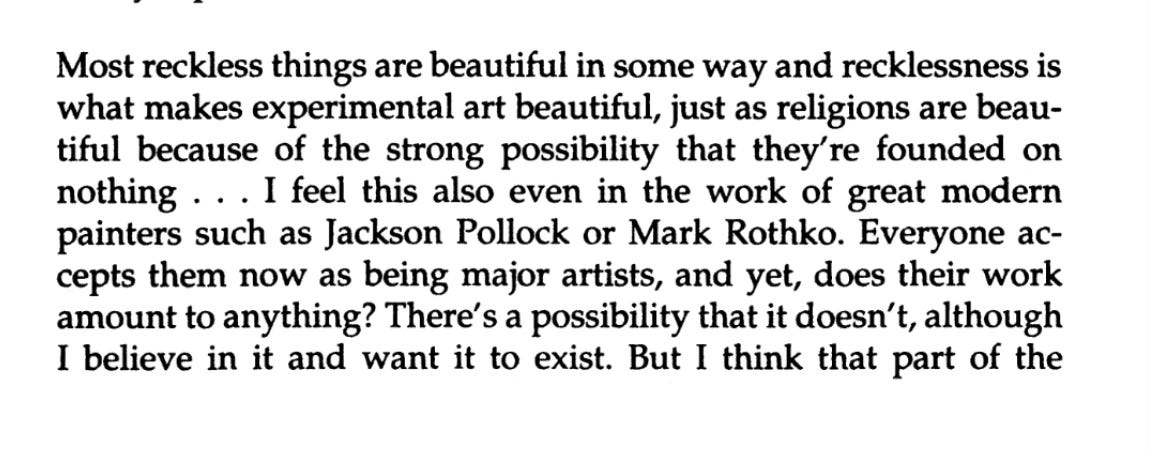
I think absence is like a spiritual radar. It welcomes and honors the dead. It makes space for the invisible. It also acknowledges that whatever appears to be going on, on the mere surface, as in Henri Cole’s charmed title The Look of Things, is not all there is. Psychoanalysis is built upon Freud’s insight into the unconscious as the royal road to understanding human beings, that is, our contradictory behaviors. It’s very possible, however, as John Ashbery describes what’s so alluring about Abstract Art, that it’s all founded on nothing. Rather than seeing this as only a weakness to certain artists, he acknowledges it’s precisely what’s so compelling.
Ashbery:
The complicated part, for me, I guess, is complicated grief. Or prolonged grief disorder. If you want to get all DSM-V about it. It seems to me that the history of poetry, which I often pin to Sappho, goes further back, even before Homer, to the story of Gilgamesh. Gilgamesh loses his friend who is really a beloved friend if not boyfriend. The second half and bitter ending is all about the possibility of resurrection, or rescue. While Gilgamesh comes close to achieving the impossible, at the last second he loses the chance. Much like Orpheus unfortunately needing to look back (anxious attachment style) to see Eurydice. Oops.
It’s all well and good to claim grief has no timeline, that even breakups whether romantic or not, need to take however long as they require to be properly processed, maybe healed. Yet obdurate, stubborn grief extols quite the price. As Falstaff says about grief: “It blows a man up like a bladder!” Shakespeare might comically be pointing to weight gain, making another fat joke, given Falstaff’s portly comportment. But Shakespeare knew an awful lot about persistent grief.
It’s why Hamlet for all his adolescent mayhem remains a kind of ethical North Star to so many (though tragic, compromised, perhaps ultimately a grand failure). For though Hamlet is a prince and privileged brat as they come, he suffers. And he doesn’t only suffer, he grieves. Hamlet can’t stop grieving though his grief is confused for mania, though I don’t think psychiatrically they’re necessarily that distinct or even opposed states of being.
Toni Morrison:
Sometimes you don’t survive whole, you just survive in part. But the grandeur of life is that attempt. It’s not about that solution. It is about being as fearless as one can, and behaving as beautifully as one can, under completely impossible circumstances.
I don’t know if there’s much that links my taste in art. But I’m sure grief and absence, the disquiet sense of being haunted, some kind of rational or irrational loyalty to the dead, to ghosts, all of it counts for something. In Hart Crane’s poetry there is the “perpetual music of self-elegy.” In Elizabeth Bishop, one feels she’s drunk a glass of tears beneath her tidy, fastidious, gleaming descriptions of nature, animals, miniature objects and scrutable things. Plenty of people enjoy melancholy and mourning as a stance for art making. I don’t know anyone that would cry out, like Claudius, “Tis unmanly grief.” Though I love that phrasing. Of being un-manned, or de-manned. But I’m biased, as a nonbinary person. I think gender roles and gender itself is like one big friggin’ exit sign.
The complicated part might be, from the outside POV, as it were, when you feel the poet or person starts to desire their living mausoleum or entombedness. Dickinson: “You who were Existence, / Yourself forgot to live.” That’s from Dickinson’s starkest, most bold elegy. But she’s chiding her beloved, too. There’s the literal why did you decide to die, as if one could forget that, like leaving a house without an umbrella or a pair of rain boots. But there’s the deeper, pervading curiosity we have towards people who seem to shrink like the snail into their shelly world: avoidant, retreating, dismissive, fearful. The world may try hard to entangle me in its joys or seductions for more life, to celebrate, to think green thoughts—but not enough.
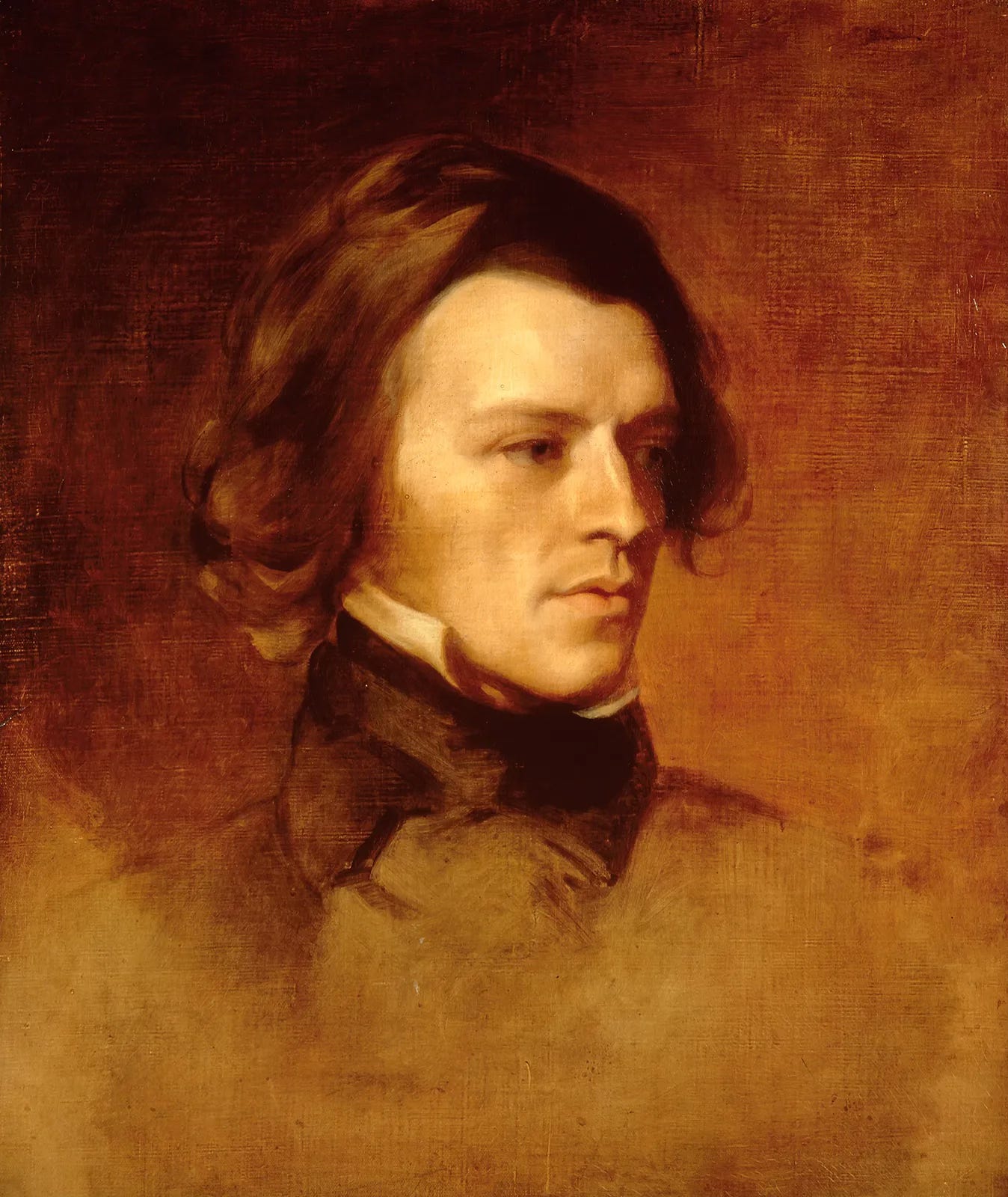
Tennyson worked on his sequence of elegies for Arthur Hallam for 17 years. Hallam died in 1833 and the work was not complete and published until 1850. Arthur died suddenly of a brain aneurysm at age 22. Talk about prolonged grief disorder. He refused to marry until he finished the book, it seems.
Siddhartha gave his clothes to a poor Brahmin on the road and only retained his loincloth and earth-colored unstitched cloak. He only ate once a day and never cooked food. He fasted32 fourteen days. He fasted twenty-eight days. The flesh disappeared from his legs and cheeks. Strange dreams were reflected in his enlarged eyes. The nails grew long on his thin fingers and a dry, bristly beard appeared on his chin. His glance became icy when he encountered women; his lips curled with contempt when he passed through a town of well-dressed people. He saw businessmen trading, princes going to the hunt, mourners weeping over their dead, prostitutes offering themselves, doctors attending the sick, priests deciding the day for sowing, lovers making love, mothers soothing their children - and all were not worth a passing glance, everything lied, stank of lies; they were all illusions of sense, happiness and beauty. All were doomed to decay. The world tasted bitter. Life was pain.
These lines towards the beginning of Siddharta (Chapter 2) always make me think of Whitman’s stretch in “To Think of Time”:
When the dull nights are over, and the dull days also,
When the soreness of lying so much in bed is over,
When the physician, after long putting off, gives the silent and terrible
look for an answer,
When the children come hurried and weeping, and the brothers and sisters
have been sent for,
When medicines stand unused on the shelf, and the camphor-smell
has pervaded the rooms,
When the faithful hand of the living does not desert the hand of the dying,
When the twitching lips press lightly on the forehead of the dying,
When the breath ceases and the pulse of the heart ceases,
Then the corpse-limbs stretch on the bed, and the living look upon them,
They are palpable as the living are palpable.
