
Weird Sonnets
The Friend

What interest me below in these sonnets are how they take a weird stance towards the sonnet tradition, either in terms of voice, form, content or audience. In Shakespeare, we have an overthrow of the Petrarchan piety that a sonnet is meant to be a poem of praise for the beloved. He renews the form through contradicting it (only to reinforce the idea that the beloved is still better, even though it’s a lie to see her as physically more beautiful). In Donne, he mutates the sonnet tradition towards holy matters: the poem becomes a revenge poem, but not of a person or entity so much as mortality itself. Hopkins “curtails” the sonnet by making the poem less than the required fourteen lines (just as in some poems, he expands the sonnet into something much longer, arguably beyond recognition). Lowell gets rid of standard rhyme; he also writes a monologue in the voice of a dead person. Myles doesn’t so much write a traditional sonnet of any kind as inhabit the condensed form to dismiss one of its (once) most famous practitioners (recently dead). Berrigan dices and slices up, collage style, Rimbaud. Bishop’s sonnet, which was her last poem before she died, shrinks the sonnet into a miniature form. Coleman blows it open and allows in quotation, vernacular, live-wire and livelier history, though it feels haunted too. Mayer incorporates the power of Choose Your Adventure Books. And Dianne Seuss brings into an unapologetic prosy, drastically diaristic vibe. The way to honor a tradition most, it turns out, in poetry, is often to violate it.
—The Friend
Sonnet 130 by Shakespeare
My mistress’ eyes are nothing like the sun;
Coral is far more red than her lips’ red;
If snow be white, why then her breasts are dun;
If hairs be wires, black wires grow on her head.
I have seen roses damask’d, red and white,
But no such roses see I in her cheeks;
And in some perfumes is there more delight
Than in the breath that from my mistress reeks.
I love to hear her speak, yet well I know
That music hath a far more pleasing sound;
I grant I never saw a goddess go;
My mistress, when she walks, treads on the ground:
And yet, by heaven, I think my love as rare
As any she belied with false compare.
Holy Sonnet X by John Donne
Death, be not proud, though some have called thee
Mighty and dreadful, for thou art not so;
For those whom thou think’st thou dost overthrow
Die not, poor Death, nor yet canst thou kill me.
From rest and sleep, which but thy pictures be,
Much pleasure; then from thee much more must flow,
And soonest our best men with thee do go,
Rest of their bones, and soul’s delivery.
Thou art slave to fate, chance, kings, and desperate men,
And dost with poison, war, and sickness dwell,
And poppy or charms can make us sleep as well
And better than thy stroke; why swell’st thou then?
One short sleep past, we wake eternally,
And death shall be no more; Death, thou shalt die.
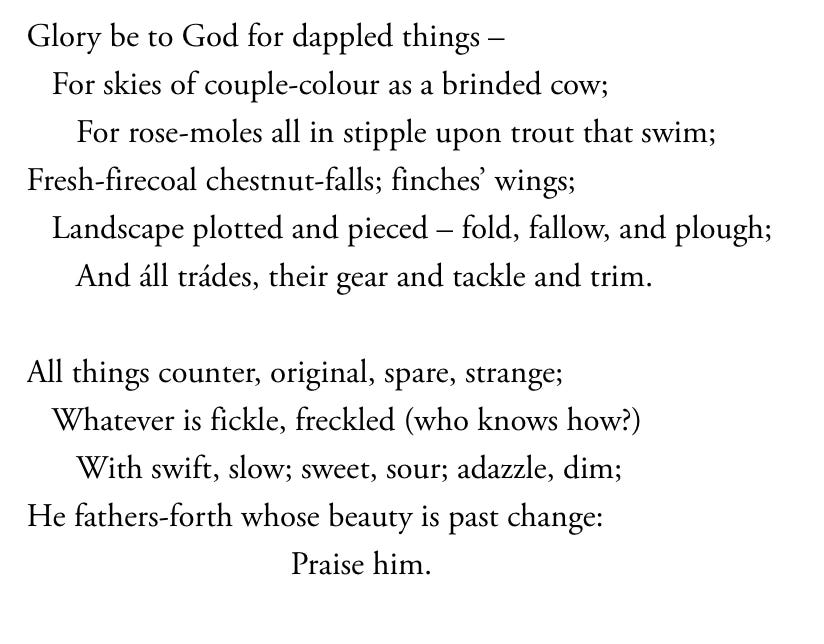
Pied Beauty by Gerard Manley Hopkins
Words for Hart Crane (1959) by Robert Lowell
“When the Pulitzers showered on some dope
or screw who flushed our dry mouths out with soap,
few people would consider why I took
to stalking sailors, and scattered Uncle Sam’s
phony gold-plated laurels to the birds.
Because I knew my Whitman like a book,
stranger in America, tell my country: I,
Catullus redivivus, once the rage
of the Village and Paris, used to play my role
of homosexual, wolfing the stray lambs
who hungered by the Place de la Concorde.
My profit was a pocket with a hole.
Who asks for me, the Shelley of my age,
must lay his heart out for my bed and board.”
On The Death of Robert Lowell by Eileen Myles
O, I don’t give a shit.
He was an old white haired man
Insensate beyond belief and
Filled with much anxiety about his imagined
Pain. Not that I’d know
I hate fucking wasps.
The guy was a loon.
Signed up for Spring Semester at Macleans
A really lush retreat among pines and
Hippy attendants. Ray Charles also
once rested there.
So did James Taylor...
The famous, as we know, are nuts.
Take Robert Lowell.
The old white haired coot.
Fucking dead.
The Sonnets: III by Ted Berrigan
Stronger than alcohol, more great than song,
deep in whose reeds great elephants decay,
I, an island, sail, and my shores toss
on a fragrant evening, fraught with sadness
bristling hate.
It’s true, I weep too much. Dawns break
slow kisses on the eyelids of the sea,
what other men sometimes have thought they’ve seen.
And since then I’ve been bathing in the poem
lifting her shadowy flowers up for me,
and hurled by hurricanes to a birdless place
the waving flags, nor pass by prison ships
O let me burst, and I be lost at sea!
and fall on my knees then, womanly.
Sonnet by Elizabeth Bishop
Caught — the bubble
in the spirit level,
a creature divided;
and the compass needle
wobbling and wavering,
undecided.
Freed — the broken
thermometer’s mercury
running away;
and the rainbow-bird
from the narrow bevel
of the empty mirror,
flying wherever
it feels like, gay!
American Sonnet (35) by Wanda Coleman
boooooooo. spooky ripplings of icy waves. this
umpteenth time she returns—this invisible woman
long on haunting short on ectoplasm
“you’re a good man, sistuh,” a lover sighed solongago.
“keep your oil slick and your motor running.”
wretched stained mirrors within mirrors of
fractured webbings like nests of manic spiders
reflect her ruined mien (rue wiggles remorse
squiggles woe jiggles bestride her). oozy Manes spill
out yonder spooling in night’s lofty hour exudes
her gloom and spew in rankling odor of heady dour
as she strives to retrieve flesh to cloak her bones
again to thrive to keep her poisoned id alive
usta be young usta be gifted—still black
Sonnet by Bernadette Mayer
You jerk you didn’t call me up
I haven’t seen you in so long
You probably have a fucking tan
& besides that instead of making love tonight
You’re drinking your parents to the airport
I’m through with you bourgeois boys
All you ever do is go back to ancestral comforts
Only money can get—even Catullus was rich but
Nowadays you guys settle for a couch
By a soporific color cable t.v. set
Instead of any arc of love, no wonder
The G.I. Joe team blows it every other time
Wake up! It’s the middle of the night
You can either make love or die at the hands of the Cobra Commander
_________________
To make love, turn to page 121.
To die, turn to page 172.
from Six Unrhymed Sonnets by Dianne Seuss
No need to sparkle, Virginia Woolf wrote in “A Room
of One’s Own,” oh, would that it were true, I loved the kids
who didn’t, June, can’t remember her last name, tilt of her
head like an off-brand flower on the wane, her little rotten
teeth the color of pencil lead, house dresses even in 4th grade,
and that boy Danny Davis, gray house, horse, eyes, clothes,
fingertips and prints, freckles not copper-colored but like metal
shavings you could clean up with a magnet. Now Mrs. LaPointe
was a dug-up bone but Miss Edge sparkled, she taught the half-
and-half class, 3rd and 4th grades cut down the middle
of the room like sheet cake, she wore a lavender chiffon dress
with a gauzy cape to school, aquamarine eye shadow, Sweetie,
she whispered to me, leaning down, breath a perfume, your
daddy’s dead, tears stuck to her cheeks like leeches or jewels.